Dev Diary: "From Baying Winds" (tentative title)
A Call of Cthulhu scenario designed for three investigators, currently in development.
May 05 2026
It's time to refocus some aspects of this adventure, and refocus myself in the process of doing this work. I have recently struggled to find ways to explain the invisible thing in the opening of the scenario, believing the key was somewhere in the reconciliation between Luka and the Hounds of Tindalos. I kept asking myself, how are these two things, from a player's perspective, any different? And in that struggling I came upon an idea that worked very well as a solution, and luckily got me unstuck. But the funny thing is that it's an idea that puts me almost back to where I initially began, before conceiving of the god in the maze concept I have since scrapped, or the idea of Luka and his family which followed from that. But I guess this is just how these things go. Progress is not linear. And at any rate I am taking with me some of the new ideas I've been working on over the past couple months forward, and I think this revision is going to prove out to de-emphasize certain things which have had the majority of my attention recently. Which will come as some relief!
The great result of all of this is that I can finally get back to working on the mystery itself, and not just the background plot that make up the details of the conspiracy. Though, I do wonder if this one idea I have, which I am calling the Soul Snare, is really all that intriguing to me and worth pursuing, or if it's another red herring to distract me from moving forward with my work...
A big reason for documenting all of this work is so I can learn something about myself from it. If I have made mistakes, then I would be sorry to repeat them again without realizing it.
April 25 2026
"These days, he is always in my dreams."
So much of my development of this scenario has been set on making the conspiracy and mystery a solid enough conceit that might actually be investigatable by players. I am also striving to make it chaotic, dangerous. It should be a thing that can be explored, but a thing which has elements that may be entirely missed by players, and thus grow even further out of control. And that is difficult, but fun work.
All of this is so far reminding me much more about plotting short stories than doing work with RPG mechanics. Though Call of Cthulhu is a system that certainly feels its most expressive when the stories have a high degree of verisimilitude, I feel. So despite my desire, and eagerness, to get on to designing stat blocks and specific checks... I am enjoying and so far maintaining faith in the process I'm working through.
I have decided that "the Invisible Thing" which the getaway car crashes into at the start of the scenario is Luka, "the Disabled Adolescent". Its appearance is a reaction to the murder of "the Doctor", a dead man's switch, made possible through an experiment to send things to and from Dreamlands and the waking world by force. While Luka was alive and living with "the Old Money Aunt" their dependence for each other grew in intensity, as the Doctor manipulated Luka so that his relationship with his family would grow strained and eventually come to be defined by animosity.
Luka was the first success story out of all of the Doctor's experiments to send someone, unchanged, awake, into the Dreamlands. In the process, he built into the ritual a bit of insurance. Should Luka experience unforseen transformation on the otherside, ahead of time, the Doctor would bend his very will toward protecting the Doctor, making use of all the animosity and dependent feelings that Luka harbored in his mortal life to fuel a compulsion to protect the life of his abuser.
Particularly sensitive to the contents of her dreams, and guilt ridden after the disappearance of Luka, the Old Money Aunt becomes a medium whereby the Invisible Thing can manifest into the waking world. When the Doctor is killed, the dead man's switch is triggered, the Aunt falls unconscious, and Luka transformed is projected into this world as a being purely set on expressing its painful binds to other human-beings, but it does so now without an object.
March 26 2026
I was reading "The Dreamquest of Unknown-Kadath" yesterday and today. The importance of the dreamland in Lovecraft's writing, the way it serves as a expository device for his mythos, and how the mythos really matters to his writing, has never really been clear to me, though I have read several other Randolph Carter stories before this. With Dreamquest... I am beginning to notice an important dimension to the anti-human philosophy which underpins his monster stories about humans being chased by beasts or sacrificing things to gods. In our world, this is the stuff of inexplicable horror. In the dreamlands, it is horrifying but more explicable.
It is lore.
But also, the dreamlands is the outer side. The space and rocket ship background which turns his monsters into grey aliens. It simultaneously makes Lovecraft stories more intuitive as works of genre and, usefully for my purposes, reveals ways that the author himself handled his mythos as material for horror stories. I don't think he could have written, say, "Beyond the Wall of Sleep," "From Beyond," or "The Lurking Fear" without first having imagined an alternative rationality and its corollary societies, without the lore of the dreamlands.
The terrifying sense of difference that his monsters and cults possess in his horror stories, I think, benefit from the verisimilitude he endowed in them through his imagining of the dreamlands. We do not know why the Elder Things are here, or recognize their cities as products of culture. The awesome horror experienced by his human protagonists derives from a failure of understanding, and then the mind-shattering revelation that comes when we fathom the improbability, or the cost, of obtaining the true knowledge which would reduce the threat such horrors pose to the ostensibly one-true reason. And this horror is so acute because, I think, it really does seem like knowledge is possible, that someone, a master of eldritch lore, understands why this is happening and why it is happening to you.
March 23 2026
Had the idea that after being transformed into "the Invisible Thing" by "the Doctor": "the Disabled Adolescent" (now, Luca) guards him like a watch dog, or reacts to his death like a Dead Man's Switch. Which is a good way to explain why the Invisible Thing appears and rushes into the road soon after the Doctor is killed by a member of the bank robbing crew.
March 20 2026
Continued to develop my thoughts for how "the Doctor" can act as a device for the drama of the story. Interesting results. Challenging work getting away from describing plot-level significance to describing narrative function that influences plot-level details. But I think I'm accomplishing what I set out to, gradually.
March 19 2026
I am starting to try to think of "the Doctor" as a device which isn't so much a character but a reason for the other characters to be where they are, to feel as they do toward each other, to be in whatever states the players find them in during the game. In my scratchpad I have begun working with this idea in detail.
March 17 2026
Created pages for "the Laborer Father", "the Doctor's Replacement", and added links to other files within them.
March 16 2026
Revised "the Doctor's" backstory, clarifying involvement with "Disabled Adolescent" and in the process inventing the idea of a family being central to this story. Seeds were planted for the fleshing out of "he Doctor's Replacement" as the "Disabled Adolescent's" uncle. And the boy's father and mother are characters now as well, with direct ties to "the doctor" and the mythos and even the location where the weird intrudes upon this world: a secondary idea, which has the miners discover oil, retrofit the mine to work as an oil rig, but be forced by the company to operate both at the same time for profit and at great risk to human life.
March 3 2026
Created "the Disabled Adolescent" character. Will use them to incorporate the conspiracy with the "invisible thing," and create a foil to "the Bank Robbing Nephew." Scrapped and moved notes on "The Ritual" concept to the archive.
February 7 2026
I've been working on Winds a lot since finishing my latest blog posts. It continues to be a fulfilling creative outlet for me. Because I know I haven't offered many specific details in these post about what it's like, today I want to share a little here about the premise of the scenario. I also want to go into detail about how I am developing this premise into a mystery, rife with coincidence and conspiracy, meant to be investigated and even, perhaps, solved.
The rules of Call of Cthulhu make up a sturdier system for character development than any other RPG from the late 70s/very early 80s that I am aware of. Even the latest edition, released in 2014, maintains that original magic, involving players in stories where existential threats, both physical and psychic, are constantly working to revise the impressions they have of their very own characters. It's a system with literary qualities. As someone who loves the interior world of realistic literature and horror, the potential of an RPG system like Call of Cthulhu has always inspired me to attempt ambitious designs.
There is a lot of advice out there for how to create mysteries. You can do it in many different ways, beginning from the end and working backward or starting with a crime and moving outward, just as examples. I had ideas and images in my head about the kind of setting and feeling that I wanted From Baying Winds to evoke. But, when I really found my way into the work, it was by beginning with the PCs.
Most of my time playing RPGs these days is with fairly inexperienced players. While I run games or when I am designing an adventure in the downtime, I am thinking a lot about ways to teach inexperienced players about RPGs through the act of playing, and how to invite them to engage in meaningful roleplay. Character creation is a big hurdle for some players. I don't just mean the actual rolling of your stats, of course. Perhaps I mean the process of identifying with a character, instead; character discovery, learning who this person is, the definition of their being, its rules derived from all the things that they aren't, assisting to identify who it is they are.
Because I want From Baying Winds to offer opportunity for complex character growth, coming up with a device to get players into this deep kind of character discovery as early as possible became my number one priority. At the risk of alienating certain kinds of players, I have decided to write this scenario for exactly three, pre-established investigators, which include a doctor of veterinarian medicine, a itinerate laborer down on his luck, and a school teacher.
Each of these characters are outsiders in the Appalachian town of Veld, which is collapsing after the Vacuum Oil Company end their operations in the region, devastating the population with a plague of widespread, sudden unemployment. Emerging from this simple setting and context is a bank robbery, the Laborer as a member of its desperate crew, seeking a valuable collection locked away in the vault of a wealthy local. Inside they cluelessly come in contact with a mythos object, a mirror showing onto the future, revealing the Laborer and his accomplices to the Hounds of Tindalos which begin to hunt them.
It ends outside in an inexplicable collision between a getaway car and an entirely invisible object. The Laborer, stranded by his accomplices on the sidewalk, sees the whole thing. Almost everyone involved is killed, including a young student accompanied by the Teacher, fatally struck in the crosswalk by debris.
And later that night, working hard to rescue a mare from succumbing to an unexpected illness, the Veterinarian discovers a young boy stealing from her medical supplies. She chases him until she decides not to. Ahead of her he disappears into the encroaching night, while the wind carries the baying of a dying animal, compelling her to return.
These are the origins of the established characters in From Baying Winds.
I was a little nervous to restrict the scenario so much, but found permission in recent experiences playing CRPGs, namely Pathologic 3 (2026), Knights of the Old Republic 2 (2005), and Fear & Hunger (2018). In each of these examples you are roleplaying as characters with established backgrounds. You learn about yourself in these games in the process of playing them, making choices through dialog or physical actions. And these are meaningful choices not because they move you along a morality meter, granting you access to expanded power, or because they represent changes in a complex state machine. Choices matter in these games because each is an opportunity for deep identification with the character as you establish an orientation to the context of a world and scenario, which your PC has emerged from. They are proper roleplaying games in the sense that the roles they ask you to play are especially coherent with the established fiction.
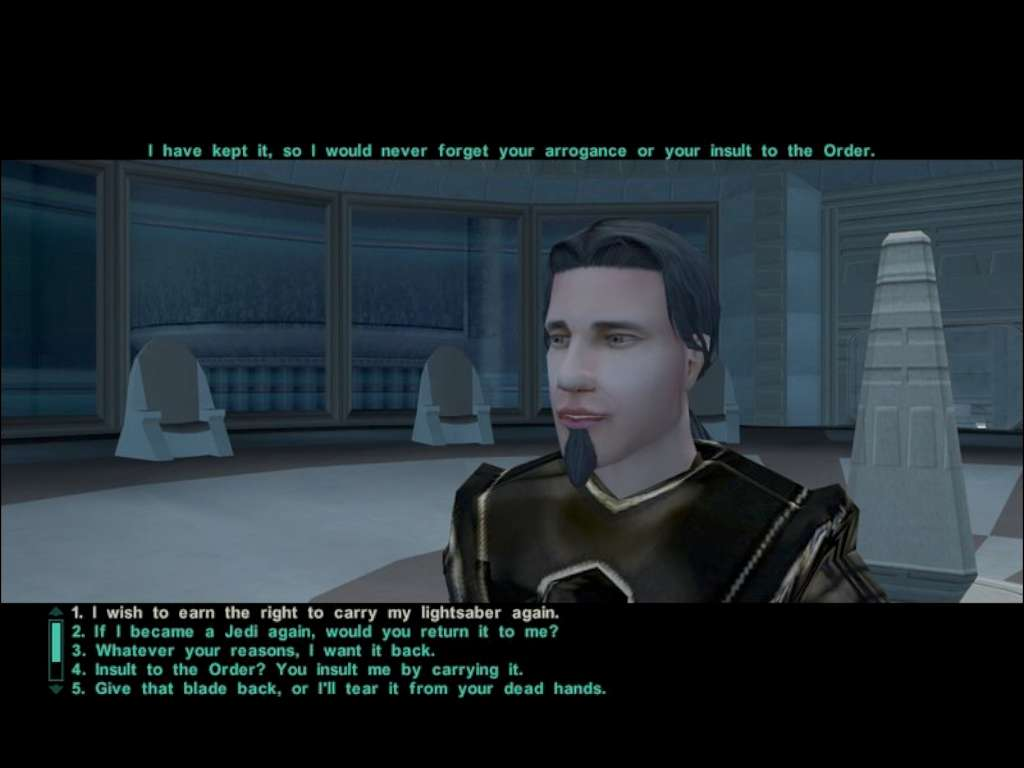
Still, I don't think it is engaging enough to tell players that their characters have gone through situations like the ones I briefly summarized above, not without offering them the authority to shape their orientation to it. But I knew both could be accomplished at once. I found inspiration in the way Fear & Hunger doles out starting equipment with decision prompts, presented as choices made during significant moments in the early life of whichever character that you decide to play as.
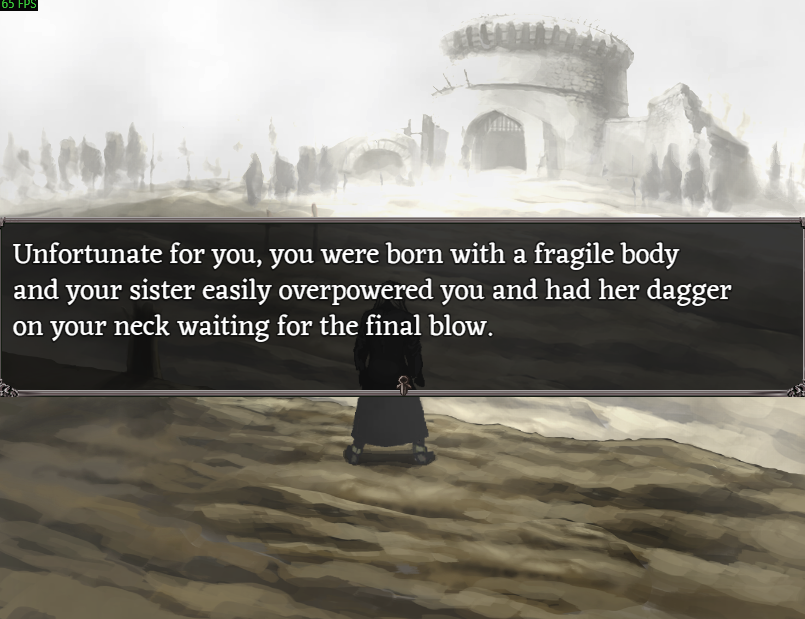
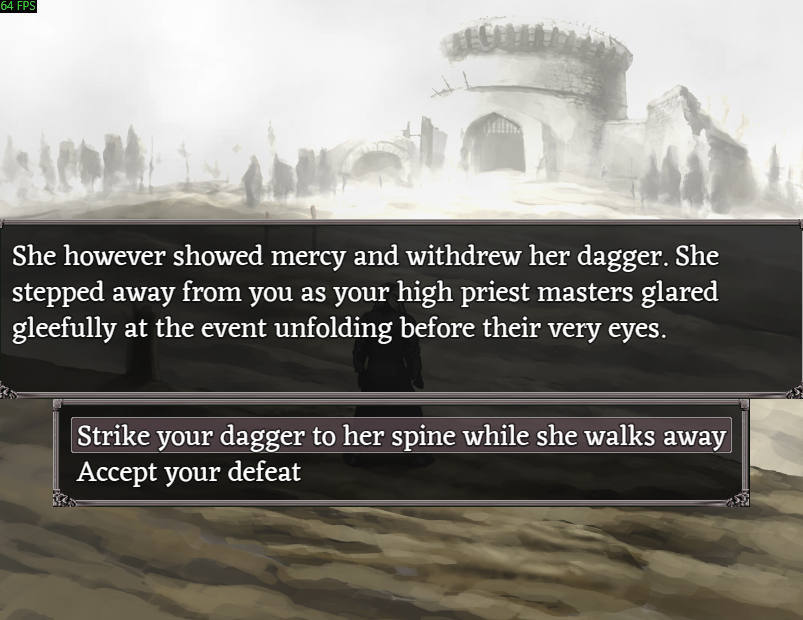
What I like about these introduction segments in Fear & Hunger is that they provide ample material for me to grasp the dark and violent nature of the world the game is set in, while the brief decisions offer a foothold in understanding my character's disposition towards it. By the time I reach the first screen of the game where I have full control over them, I will know enough about my character to actively decide what it means when I go rummaging through the various crates scattered around, searching for rotten food to eat: I am a noble born brought low, but with enough sense beaten into me to have no delusions about what it will take for me to survive.
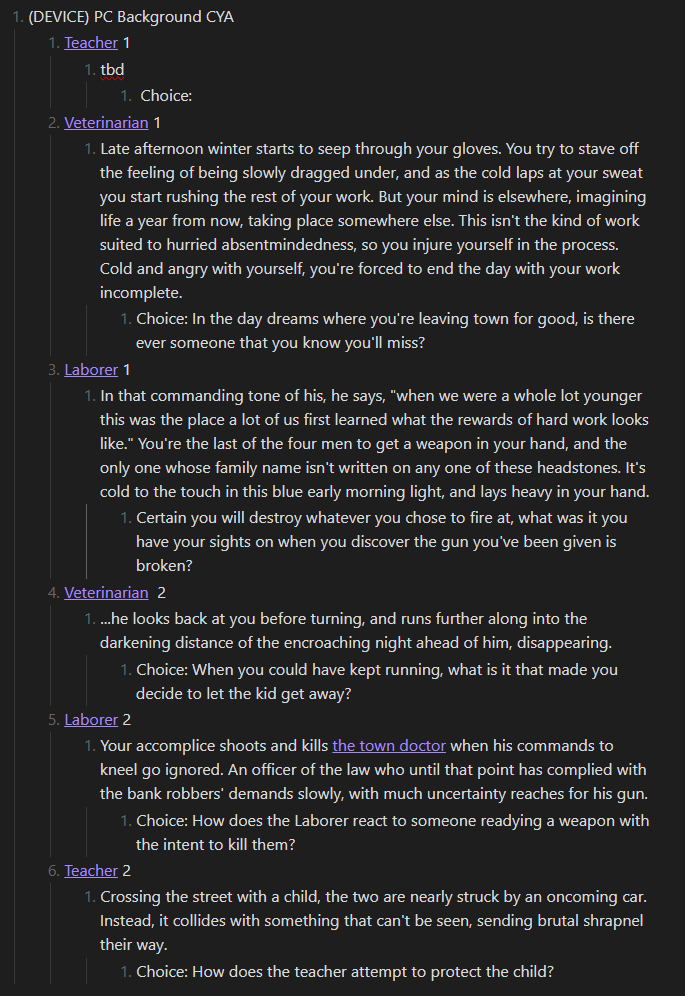
Attempting something similar, I came up with a design that presents the origins of my PCs as an interactive prologue, a sort of session 0 activity. The basic structure of the prologue involves leap-frogging vignettes narrating moments from the PCs perspective on the day of the bank robbery, each concluding with a question intended to get players thinking about that character's disposition. These prologue vignettes are strictly narrated by the Keeper. The actions of the PCs are pre-determined. But, importantly, the meaning behind these actions are what I am inviting players to become the authors of. Take this vignette as an example, the first in the Laborer's story...
Narration: In that commanding tone of his, he says, "when we were a whole lot younger this was the place a lot of us first learned what the rewards of hard work looks like." You're the last of four men to get a weapon in your hand, and the only one whose family name isn't written on any of these headstones. It's cold to the touch in this blue early morning light, and lays heavy in your hand.
Question: Certain you will destroy whatever you chose to fire at, what was it you have your sights on when you discover the gun you've been given is broken?
The writing of both the narration or the question in this example isn't final, but I feel even this would get at the sorts of insights I want players to discover about their characters. In my slight historical understanding of RPGs, it seems to me mechanics on average have usually tended to add definition to events where players make big actions, aiding to describe strikes as strong or weak, observations as keen-eyed, efforts as particularly effective or not. But by contrast, it isn't until relatively recently that the significance of actions, and not necessarily the outcome of them, finds mechanical support to describe something about the interiority of the character performing them. I think of these exciting scenes from the recent Pathologic 3 where you switch perspectives between your player character, the Bachelor, and an inspector who is interrogating him, controlling the responses of both characters. Having to issue attacks and make defenses is disorienting. It's perhaps comparable to an exercise of self-criticism, with its ultimate goal being the discovery of insights through a synthesis of opposed perspectives. These interrogations are usually concerned with the meaning behind actions which take place during parts of the story you haven't actually had the chance to experience yet. And even through this oblique approach to accessing the truth of this character, it still feels like you have established a vital identification with your own version of the Bachelor.
Lifting this outright wouldn't help me much, but it's a great example (and source of encouragement) of how to quickly involve players in the kind of deep identification with their PCs that I've set for myself as a goal with this project. It's just an added convenience that my design for this prologue sequence also helps with establishing the setting of From Baying Winds, moving through a series of events which directly involve the PCs, revealing the mysterious conceit of the scenario, the hook and the mystery. It should be a fast and easy to run, meaningful to the players. and useful for the keeper. And so far I think that it will be.
Have a look at my work in progress in the screenshot below. Maybe it will give a clearer picture of what I am working towards if you have this to reference
It's easy to design a mystery for Call of Cthulhu that ends up fragile. I've found myself longing at times for more control over the game, despite valuing the basic dynamics of collaboration intrinsic to tabletop roleplaying. Rather than feeling disappointed because of the way things play out, the clues that investigators miss and the connections they never seem to make, it's the tropey explanations behind the way investigators find themselves working together in the first place that annoy me most. The impetus is an important part of a story. Allowing Call of Cthulhu games to always begin with a contrivance, like the investigators are working a contract, or were called upon by a friend they all have, has always felt to me like such a waste of good potential.
I want From Baying Winds to feel literary, engaging, to show that it is interested in getting more out of players than pass/failure results on POW checks. I am putting a lot of attention on this specific design because, though it's slight, I believe it aims to address many problems in an elegant way unique to most Call of Cthulhu scenarios I've read, and certainly others I've created.
February 6 2026
This project needs a codename. "Coincidence and Conspiracy" is a thematic shorthand I've used in my notes, but those are two fairly long words. And if I am going to give something a long title, let's get serious about coming up with something real.
I'll title this scenario From Baying Winds, for now. Baying Winds for short. And just Winds for even shorter.
January 25 2026
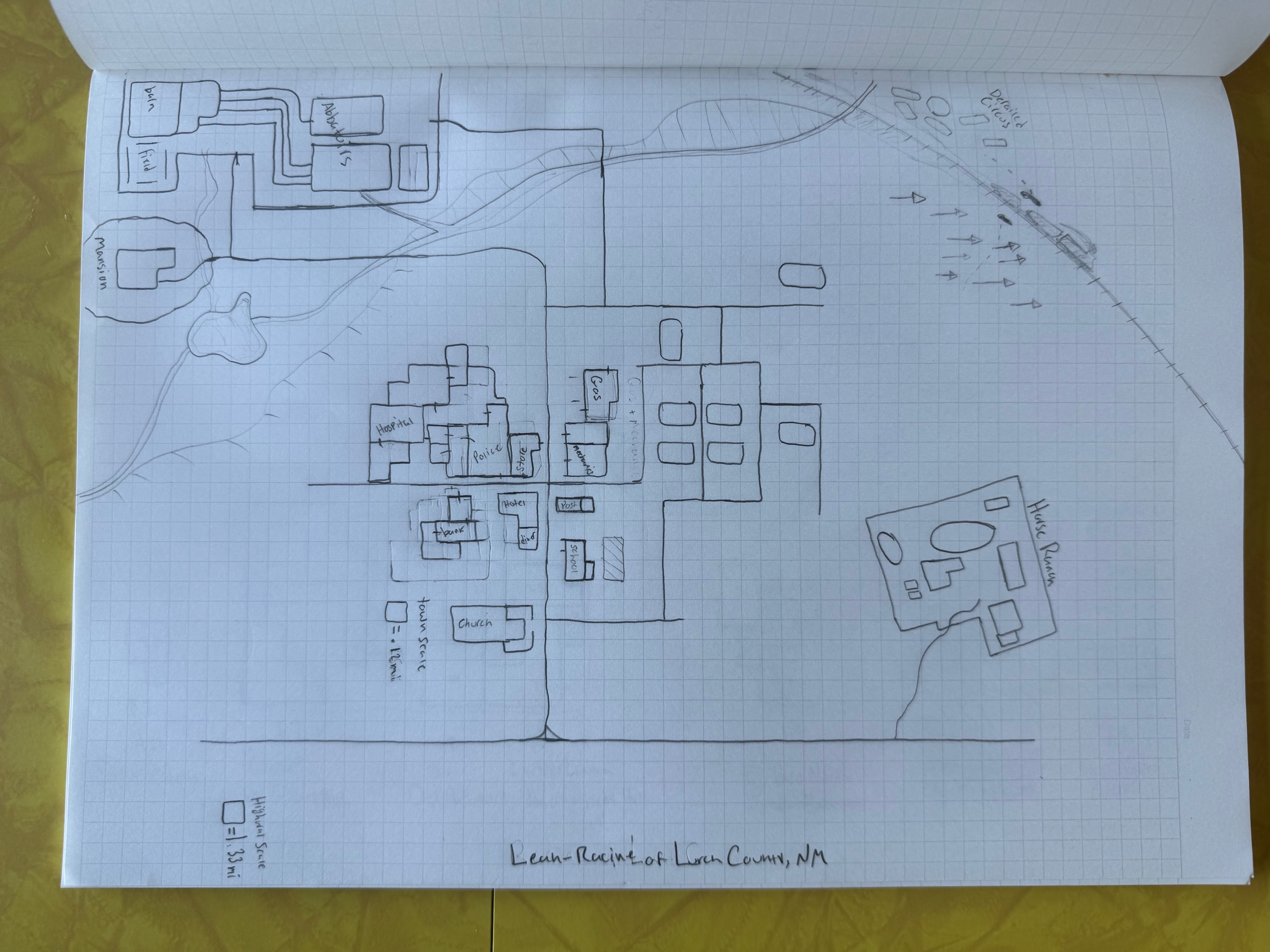
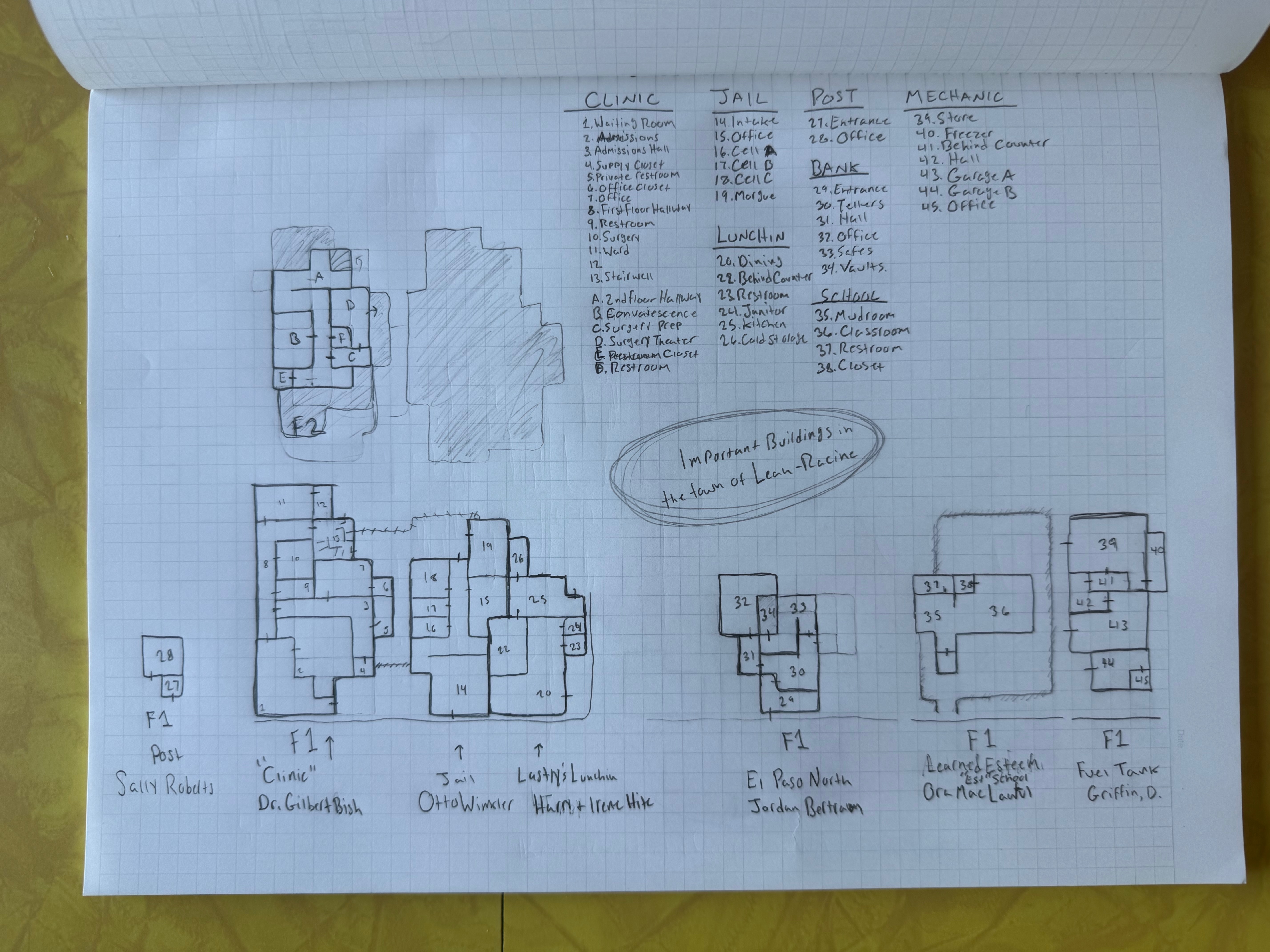
Work proceeds on this project between many other things, but I wanted to document some maps I created. These are meant to detail the buildings along the main road (and a bit further out) of the town in which this scenario is set. I've recently decided to transpose all of this story from New Mexico to a more conventionally Lovecraftian setting, something Appalachian found in works like "The Lurking Fear", Mignola and Corben's "The Crooked Man" or the Hungarian forest setting at the end of Thomas Pynchon's latest novel. Much of this can still be used but will see some big changes when I'm through with everything.
December 27 2025
Involving myself in something new, like this, my project to produce and publish a pre-written RPG scenario, is beginning in classically overcomplicated fashion. At the start these things appear as a vast landscape of aesthetic, theoretical, and practical concerns unfolding like a triptych before me, revealing a mass complication in need of contemplation and tidying. Looking at the details, I can see challenges which will be easy to handle because they are familiar. But among them are problems that are less similar and merely analogous to other problems I've encountered in the past. Because it is very easy to become distracted with things that don't matter to your practice--and because it is pivotal that this doesn't happen at the beginning--I sometimes have the good sense to leave these alone forever or at least until a later moment. The overwhelm that accompanies trying to handle a problem you don't even understand the intricacy of via means that are inappropriately suited all in service of an aim that you haven't even thoroughly considered may not be actually worth your while, is, I think, what leads to a lot of failed projects.
Luckily I am just stupid or arrogant enough to think I can eventually sort through most great confusions, so it just seems like a fun challenge to try to overcome. But honestly I think this feeling I have is actually based on something. There's an interesting problem before me. As an essayist/fiction trying to create that archaic and often scorned document, a pre-written RPG adventure, how do I make sure I'm not accidentally writing a novel when I should be writing... well, what the hell is a pre-written adventure exactly?
The greatest challenge this project has so far posed is the need to discover a practice for developing an adventure scenario with characters, scenes, and a plot that is intelligently distinguished from a practice you would deploy for use in the similar but distinct prose fiction/non-fic form.
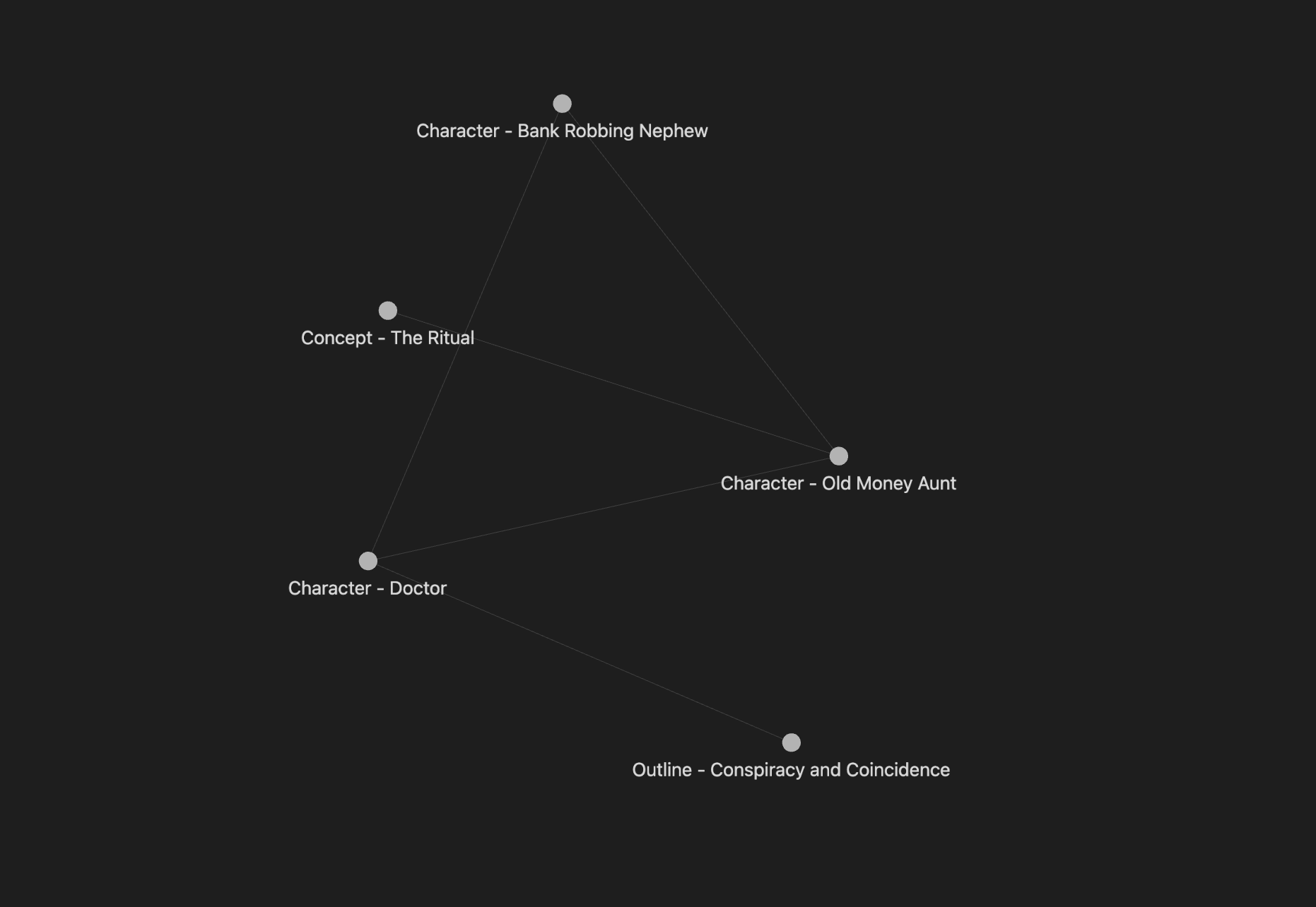
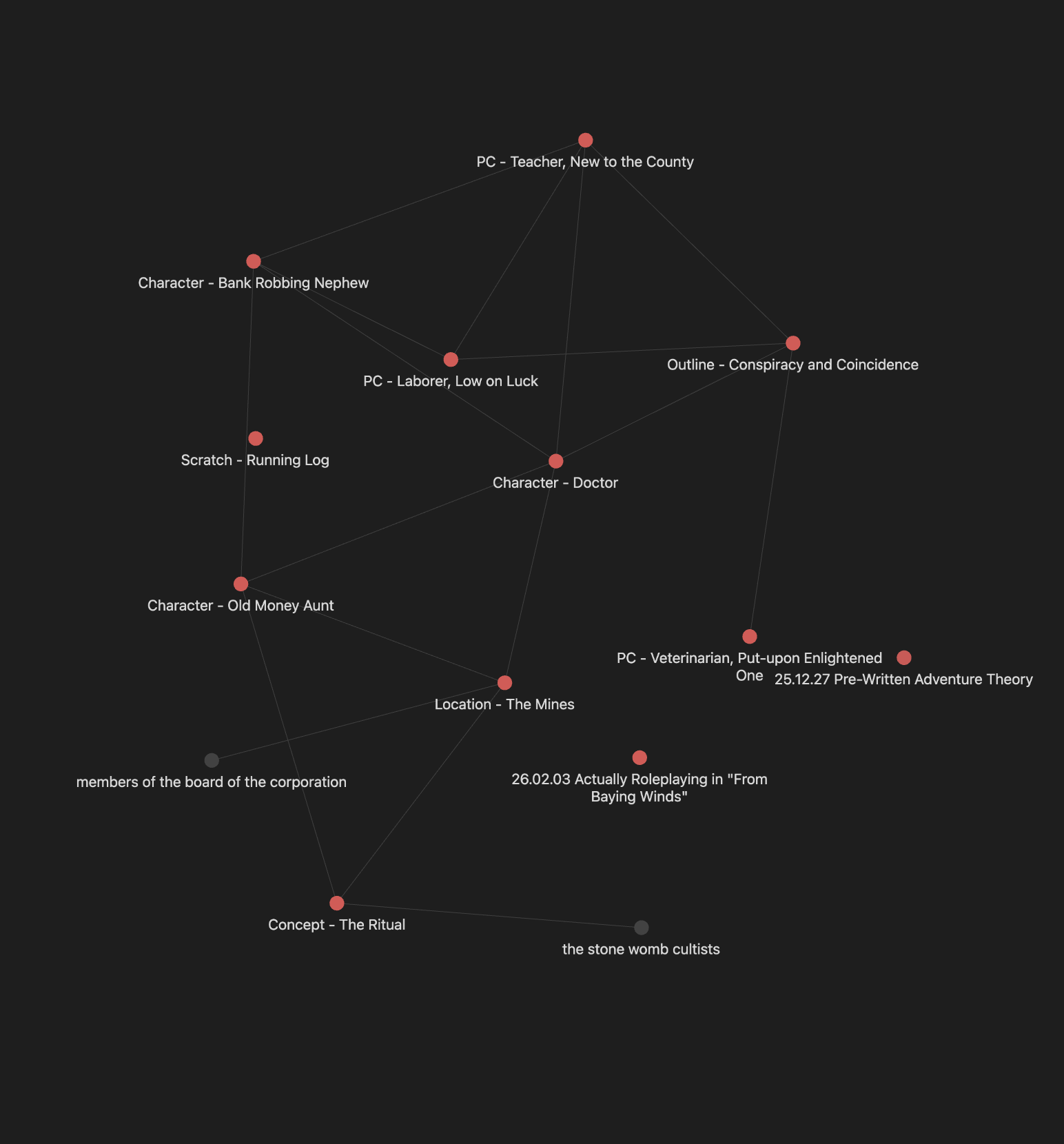
The kind of story that is created and experienced by players of an RPG is clearly not the same as a novel, or likely any other prose forms that are meant to be read for entertainment or conveying a story. But the craft and theory behind a pre-written adventure isn't something I have heard any discussion about. Where to begin discovering your idea for a story except just by telling it? Get to writing. The problem is it has so far tended to come out in paragraphs of sketched personalities or a plot structure. But among the mostly fully-formed sentences were, I started to notice, graphical and informational forms like bullet points and webs which seemed to hold promise. Knowing that it would be important to break free from writing this scenario as a novel that I would later need to translate into an adventure scenario, there was a time a few weeks ago where I found myself fleeing from prose paragraphs into the organizational logic presented by those bulletpoints, lists, and diagrams that I found absolutely necessary for establishing even the scenario's most basic premises.
There is a lot I need to research further, but at this present moment, in my ignorance, I feel like a pre-written adventure scenario should present the scenario to the referee as a database written in prose and graphical elements. Maybe I am trying to come around describing the concept of a manual in a very hard way, but I just want to explore possibilities here. Tables and prose are not strangers in a world filled with published RPG materials. Wargaming, etc. The B1 adventure module "In Search of the Unknown" for the 1981 version of Dungeons & Dragons reads almost like a 30 page bullet point list with description thrown in as handholds to prevent a would-be dungeon designer from drowning. Glancing at the materials published for the same wizard game in more recent times, it's unclear, but innovation they perhaps have claim to over those modules from 40 years past is that they found that there is some benefit (to players, referees...?) in increasing the amount of prose.
My foolish hope is to find innovation somewhere between In Search of the Unknown and the creation of my scenario that presents a revelation the way that Quentin Fiore's collaboration with Marshall McLuhan on The Medium is the Massage, which translated McLuhan's sociological media analysis into a different form with different affordances (something I attempted to do with Situationist theory for a zine I made years ago), maintaining its intellectual goals, which could reach people in ways previously not easily accomplished. So far I haven't read too many pre-written scenarios. Besides the previously mentioned, and the B2 "The Keep on the Borderlands" scenario, the only other I have really studied is a particularly interesting example of what I am talking about, the learning scenario by Skerples and Co. titled "Tomb of the Serpent King". But I mean to conduct a broader survey throughout 2026 to see what people are doing, and hopefully find some inspiration for ways I could pull it off and make something cool but unique too.
November 21 2025
I am spinning up this web page to document my process as I develop an adventure scenario for the Call of Cthlhu RPG (7e). I began working on this untitled scenario on October 20 2025. My intent is to produce an investigative horror scenario to run for three of my players (my partner, Grace, and Luke) either over a play-by-post discord I have set up, or synchronously via voice chat on occasion. Besides making something quality, which is informed by the history of the early 20th century American setting, the noir detective genre, and the spirit of Lovecraft's weird horror, my secondary goal with this project is produce enough of a document to self-publish this scenario as a free PDF for other players.
My desire to design, produce, and publish a scenario goes back to the last time I was running Call of Cthulhu for friends when I was in grad school. I was running them through a vaguely sketched out scenario of my own creation that provoked some genuinely fun, or eerie, or intriguing moments of play. I always thought I could return to my notes from then and turn them into a functional and thoughout and complete scenario. I feel starting on a new project is the move to make now. Compared to who I was in grad school, my understanding of RPGs and genre has changed. I have had a bit more experience running games, too, and know a little bit about what makes for fragile scenario plotting. This new adventure should be scarier and more intriguing on its merit as a horror investigation story, with a strong premise and a well thoughout mystery. But it should also invite my players to play an active role within it.
Basically, my goal here is to do good work. And from my time creating stories and games I know doing good work is very very hard. I'll be leaning into my instincts on this project, trusting my gut (which isn't and hasn't always been easy) to discern when my ideas are actually worth keeping because they are good or if I think they are worth keeping only because they make it easy to just keep working. This isn't work for the sake of it, but work in service of doing something well. And that feels liberating. It excites me.