Memorial for the War of the Harvest Nobles Pt. 2
The opinions expressed in this and other writings on my website are solely my own and do not express the views or opinions of my employer.
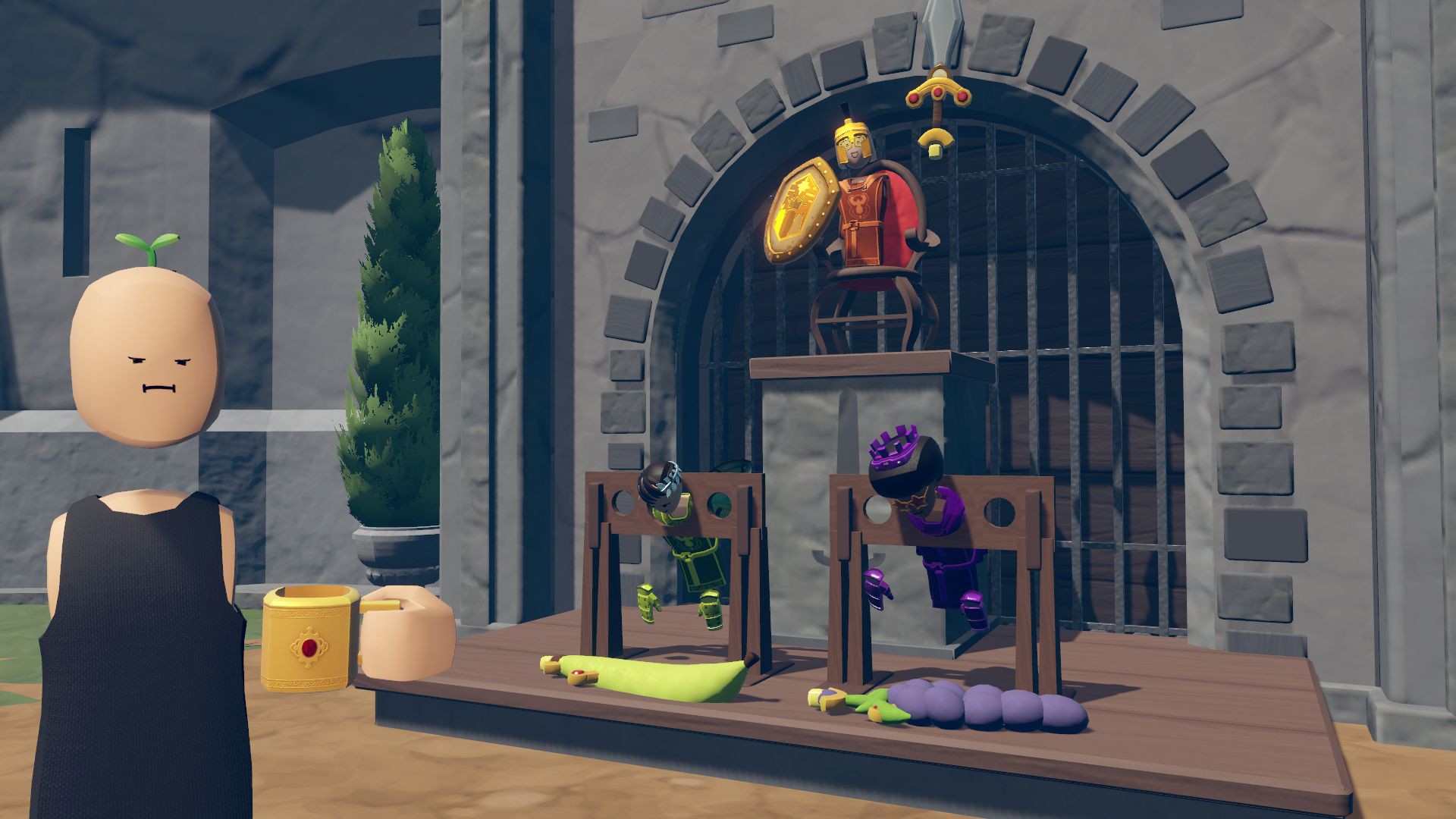
War of the Harvest Nobles was a Rec Room competitive leaderboard event, for which I served as design lead, taking place across three weeks during the summer of 2025. It was a three-way battle among Rec Room's population where nailing opponents with throwable, rotten tomatoes would score you points and cause them to emit noxious clouds of stink. Compared to Rec Room's previous competitive leaderboard event, Glitch Grenades, which War of the Harvest Nobles was intended as an iteration, this event entailed meaningfully expanded competition dynamics and opportunities for community engagement.
Our goal as a team was set by company mandate to produce an event with deep spend potential using tech that we had already invested in to gain new learnings about what more could be done with competitive leader board events. I had my own concerns with this event as its designer. I felt it should present itself to our players as a scenario free for them to engage with through whatever means they could afford, be that directly via the economics of the competition, as roleplaying participants in its unfolding story, or by contributing to the spectacle of the event online in our community spaces outside of the game. I also had artistic ambitions that the event could somehow communicate something about shared frustrations between players and developers toward decisions made by Rec Room which signaled that it valued the social play aspects of its product a great deal less than the creators of a game like this should.
In service to the objectives of the company, as designer of the event, my job was to focus our efforts toward realizing a vision that would satisfy ends both economic and aesthetic.
1. Structure of the Harvest Nobles
Essential to unlocking affordances that would help us to accomplish our goals with this event was increasing the capability of our leaderboard system, enabling us to collect and present data for competitions between multiple teams and even sub-groups within them. With this event I was wanting to address, in a creative way, a complaint that arose among our players when we ran the previous event using only the one leaderboard. As I wrote in part 1 of this devlog...
"Many players interpreted Glitch Grenades cynically, as a design intended only to create revenue for the company by targeting the wallets of players who have the greatest sources of income, either through monetized creations of their own or influence through social media.... [This] is not an entirely ungenerous interpretation, I believe. After all, the only kinds of players who proved able to compete for high ranking positions during the event were, in fact, the already wealthy and influential.... Among players of a less affluent demographic Glitch Grenades created cause for alienation while engendering resentment aimed at wealthy content creators paying out hundreds of dollars to hold onto their leaderboard positions at the top."
Exploding Glitch Grenades' single leaderboard format made it possible for us to create the conditions for a specific narrative and mechanical scenario that I wanted War of the Harvest Nobles to progress from. This event would be primarily a competition between three factions, which themselves were divided into two: a class of so-called Nobles comprised of our most influential content creators alongside our biggest spenders; and underneath them an army of conscripts, or Knights, made up of the rest of the population automatically sorted into one of the three factions.
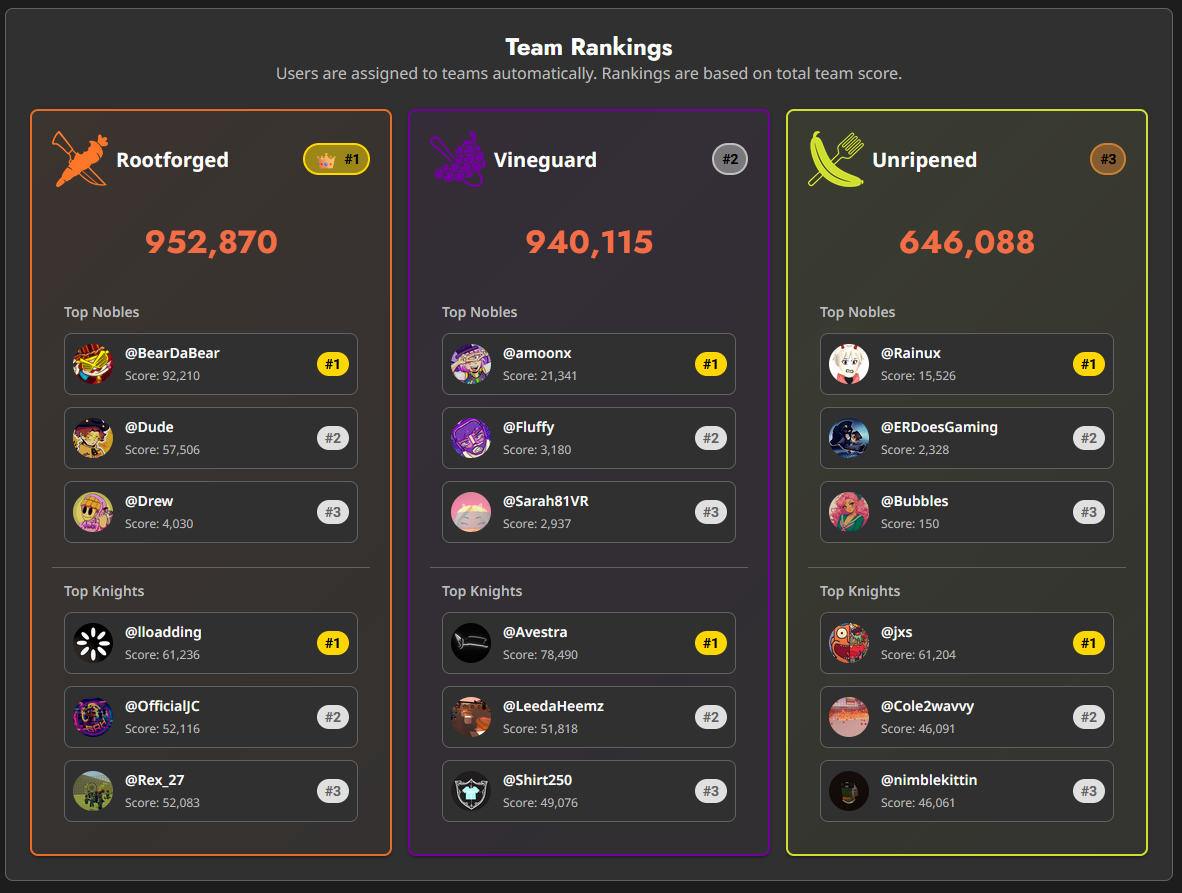
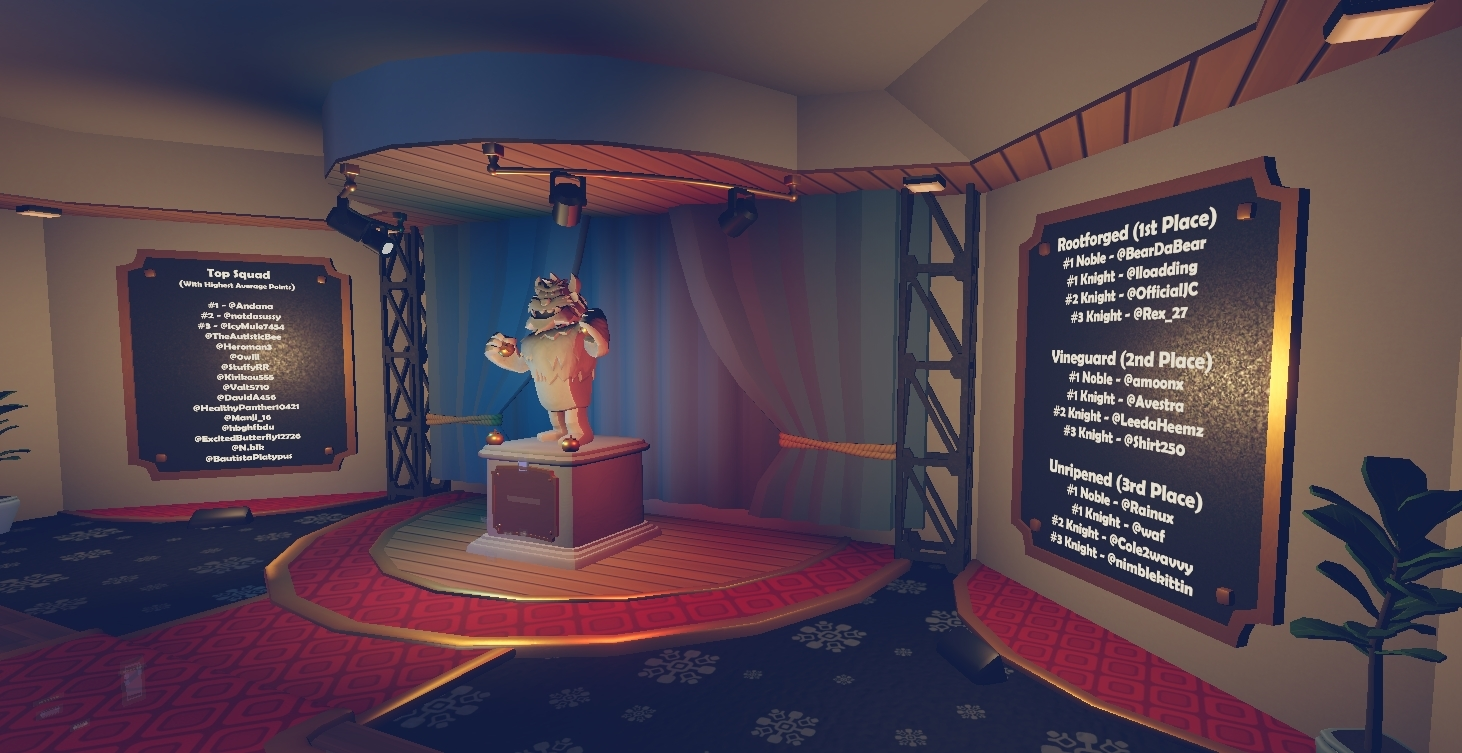
Within their own factions, the individual contributions of every Noble and Knight would be weighed on inter-faction leaderboards, rewarding the top three players in both classes with exclusive items and the unique opportunity to have their names memorialized after the event was over in a permanent fixture within Rec Room's main social hub, the Rec Center.
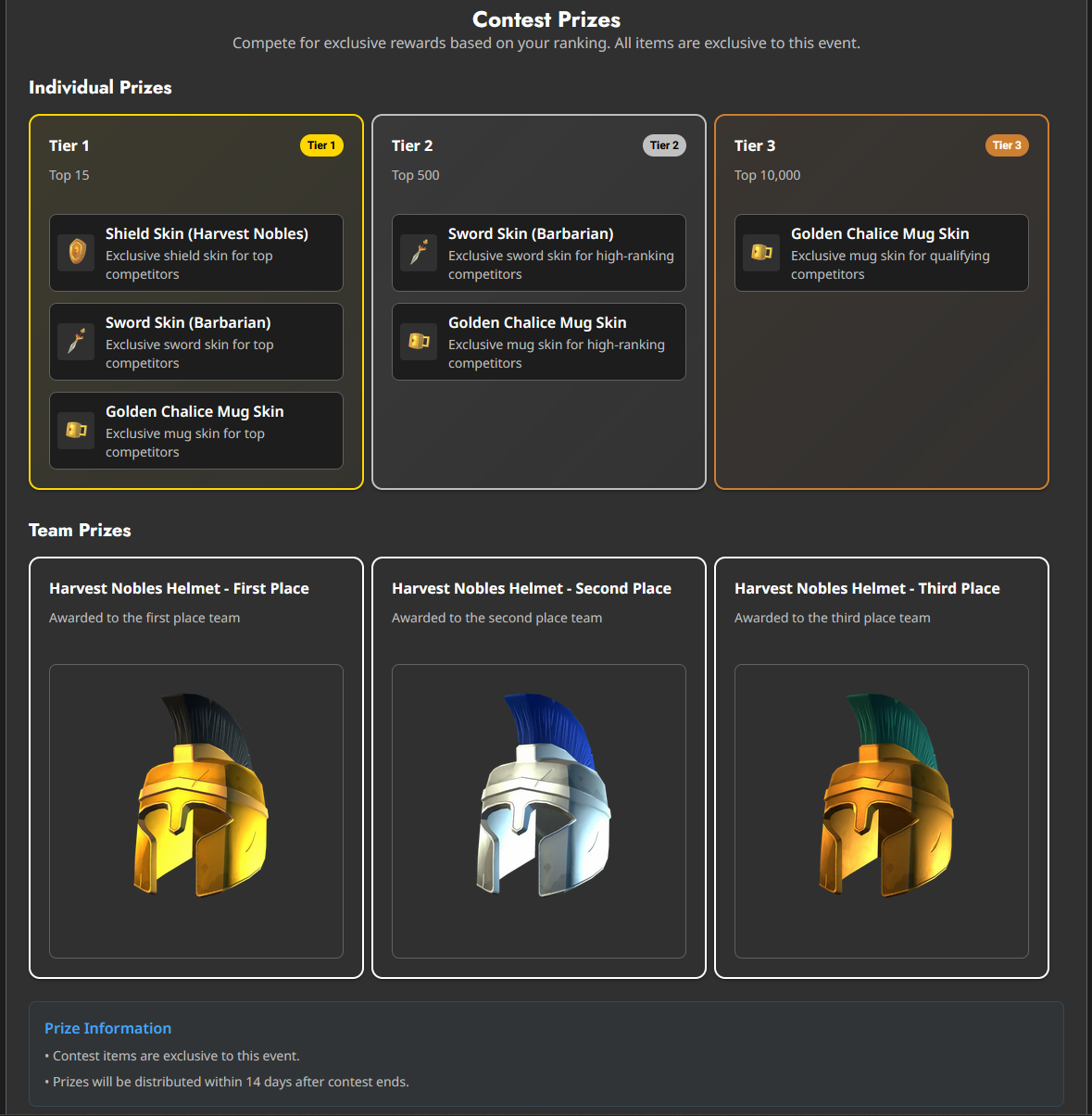
Individual performance would earn players renown, but, with a faction's overall score in the three-way competition comprising the summation of contributions made by everyone within it, exclusive first, second, and third place cosmetic items were rewards that every member of a faction could expect to receive at the end of the war. Rewards were also on offer for top scoring participants, regardless of faction, in bands of 15, 500, and 10,000.
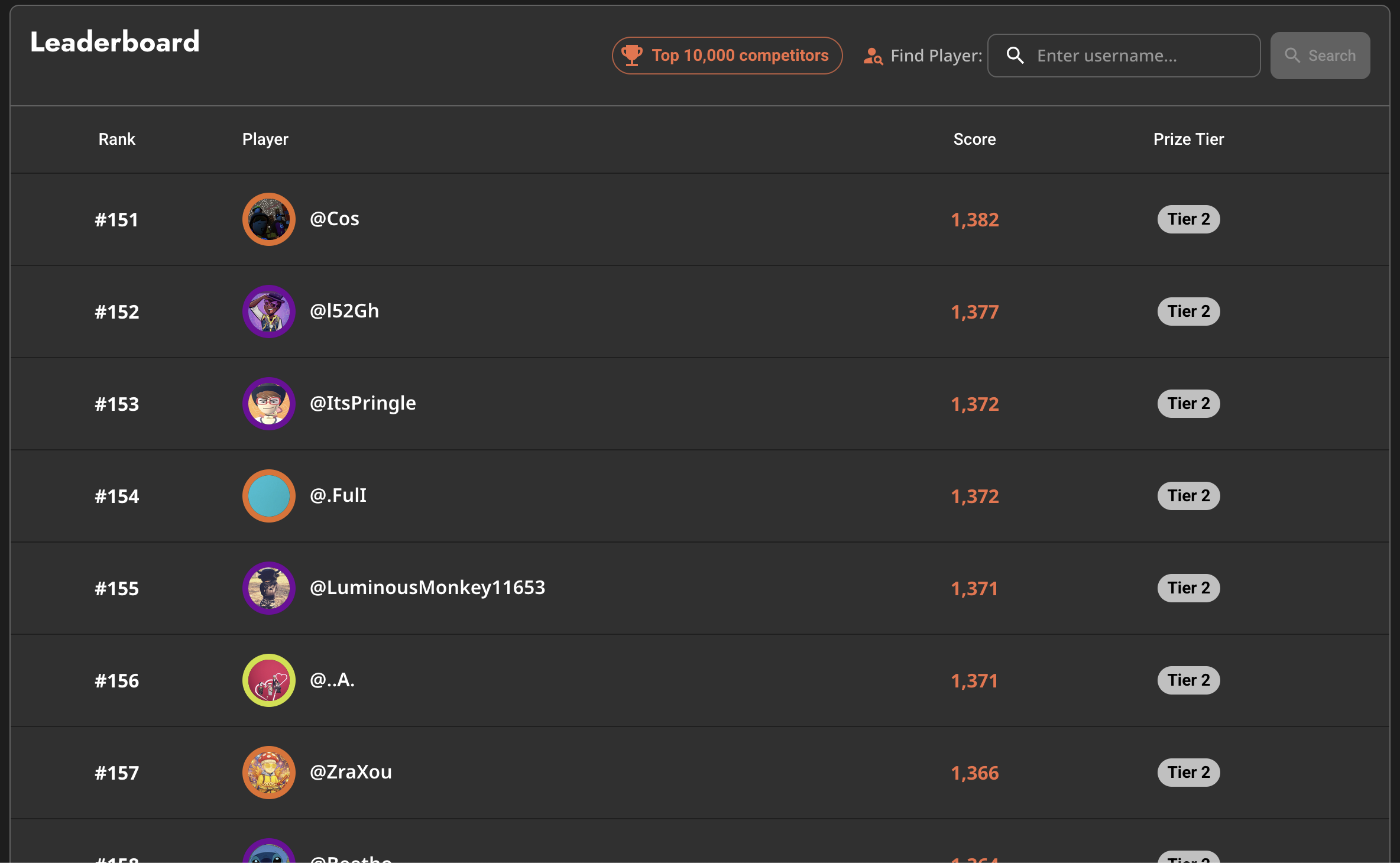
The position of a player across all leaderboards—individual and interfaction, as well as how these positions relate to the standing of their faction within the overall competition—was intended to reflect the degree of that player's influence, or their subjectivity, as a Noble or Knight within the story of the event as a whole. The interrelatedness of the individual to the collective was a pillar concept in the design of War of the Harvest Nobles.
Interrelatedness was even incorporated into the event's purchasable, the baskets of rotten tomatoes, a Noble or Knight's sole means of scoring points, with its six throwable tomatoes that may be used by anyone once placed in the environment, but must first be purchased by someone. As battlefields formed, and loose tomatoes and baskets began to litter the terrain, I wanted there to be a dynamic tension around the use of tomatoes, either by capture from members of opposing factions, or the proper guarding and deployment of them by wealthy faction members that supplied them and the knights who would take them up.
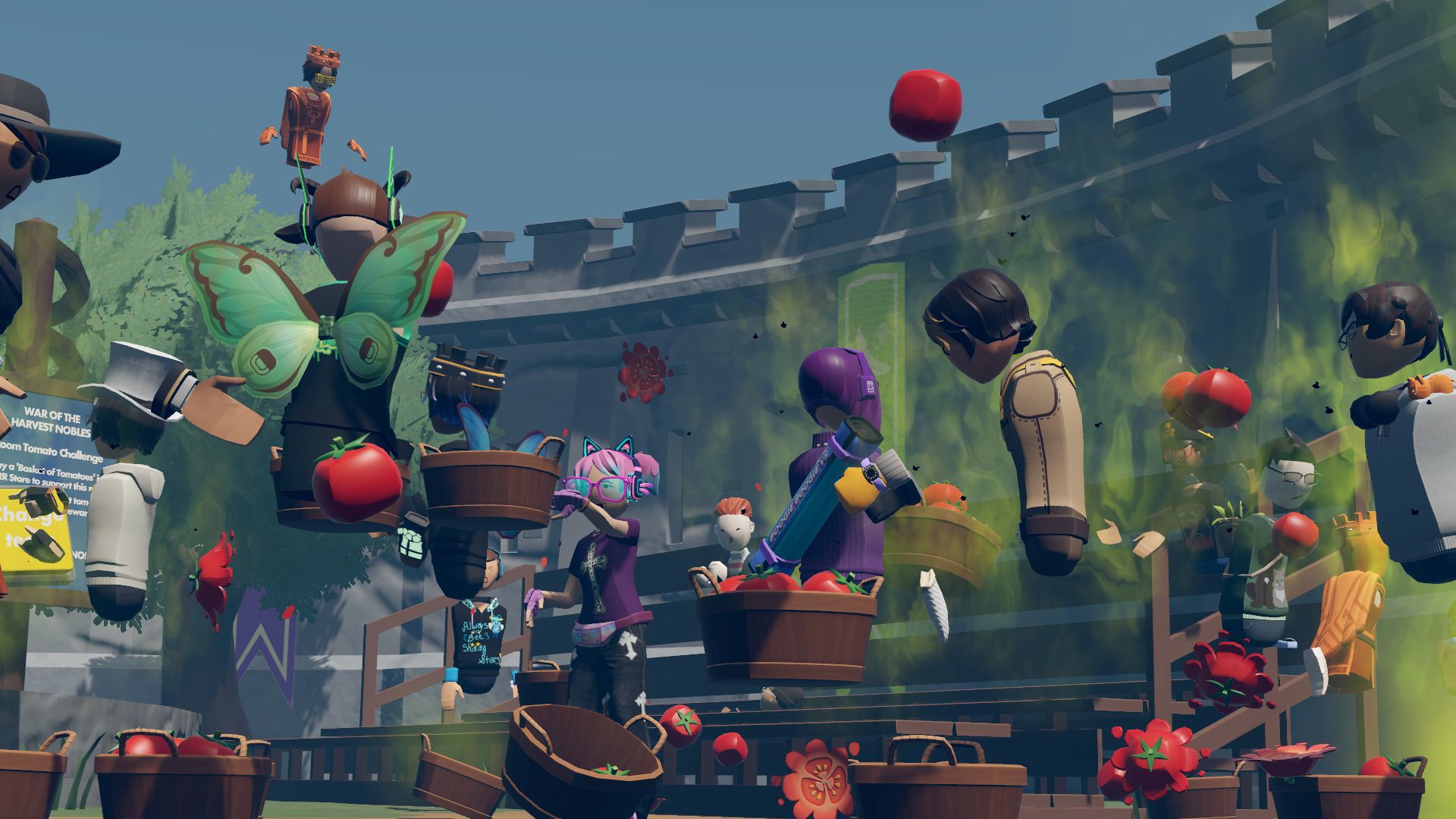
The tomatoes, like one's position across all leaderboards, were designed this way to help establish an interrelated and dynamic context that players could use to form a relationship to the competition and the dramatic atmosphere of its story. As such, even if a player was not wealthy, or particularly good at landing hits with throwable tomatoes, and even if their faction came in last place, the interrelatedness of all these things showed that the story of the way the war progressed was also the story of the role you played within it.
There were business reasons for going to all this trouble of course. But more importantly there was clear promise in this structure to create story affordances for us to work with and fun interactions for our players. As a follow up to Glitch Grenades I wanted War of the Harvest Nobles to extend an invitation to all players, welcoming them to engage with not only the competition's economy but contribute to the atmosphere and drama of its narrative about warring medieval factions as well. We had hopes that Knights of each faction would rally around the wealth and leadership of their ten to thirteen nobles, rather than flunking out in despair from an inability to keep up in an all or nothing competition against them. And in order to court the support of their Knights and coordinate efforts against other factions, guiding their own to victory, we prompted Nobles to use their platforms and creative talents for advertising, content creation, and roleplay events to help.
2. Drama of the Harvest Nobles
And we saw plenty of this sort of community engagement during the competition, but throughout the previous week, too, when I first started to reveal the story of the event to the community. War of the Harvest Nobles was, in actuality, the conclusion to a three week story encompassing our annual medieval-themed sales season. Since the competition was scheduled to begin at the end of the sale, I saw an opportunity to unify the advertising for these week long events with a frame narrative unlike any we have attempted at Rec Room before.
Created by Rec Room (Source)
Rec Room occasionally deploys a narrative conceit to lend some of our first-party productions the premise that they are stage plays put on by a theatre department within the campus where our game is set. My thought was, for Medieval Season this year, which is ordinarily a sales event accompanied by a rethemed Rec Center, a whole campaign of narrative events could occur across a three week period presented to the community as an immersive and inclusive production put on by the theatre department.
The story would begin with a teaser, of course. Then, at the start of Medieval Season, we would announce the commencement of a great celebration, called Festival of the Harvest Nobles. Soon, at the conclusion of the first week, the mysterious disappearance of the King would usher in an election for his replacement, called Nomination of the Harvest Nobles. And, finally, when a democratic election fails to close the power vacuum after several days, disagreement turns the great Noble houses against each other, and the War of the Harvest Nobles begins.
Rec Room does not have great tools for conventional storytelling; there are no cutscenes in our game, places to display and make digestible large amounts of text, and our methods for presenting players with news updates in-game are not very robust. However, my previous work creating viral marketing for our recent glitch-themed events had proven that our community Discord could be leveraged where our tools and lean marketing budget most confined our ability to engage players in the responsive way that our recent LiveOps ambitions were compelling us to attempt. Story in Rec Room has usually been presented indirectly, through suggestion in environmental design, so my plan to create a narrator to communicate story events through Discord was both a novel and inexpensive solution.
Our narrator would be used to draw awareness, create anticipation, announce and tutorialize in-game mechanics, as well as establish a certain tone while prompting players with scenarios to foster as much of an immersive story experience as could be created with our environmental design, art assets, and through this unique leveraging of our social media platforms.
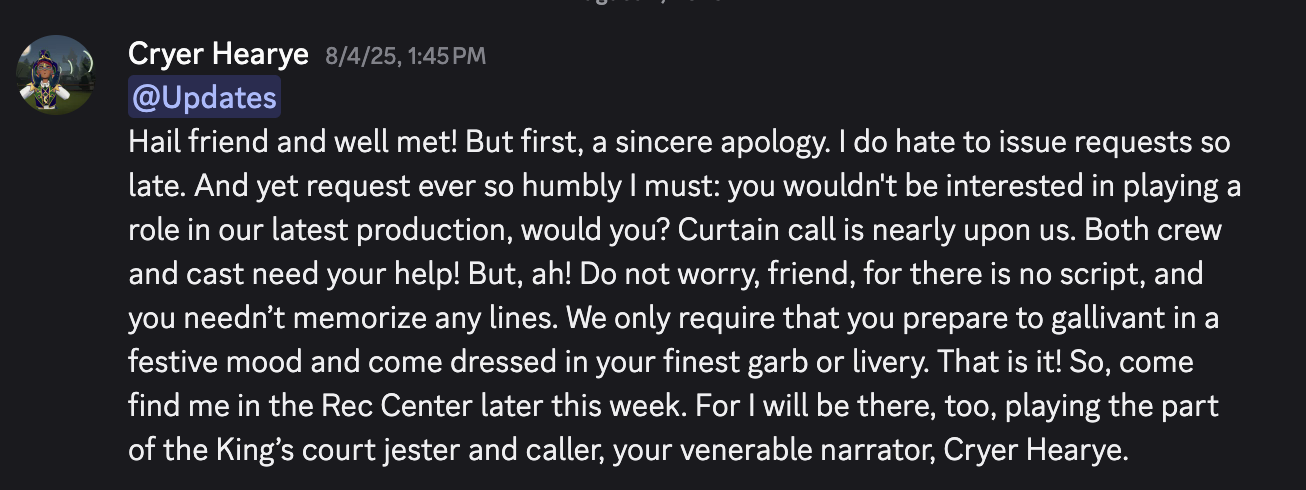
Cryer Hearye debuted herself to our community on a Monday with an unexpected first post, energizing our players with references to the established Theatre Department narrative conceit, inviting them to participate in an upcoming production.
Three days later, Cryer Hearye would star in an announcement video posted to our YouTube channel, kicking off the medieval season proper inviting everyone to partake in the Festival of the Harvest Nobles.
Created by Rec Room (Source)
A town crier was chosen for some obvious reasons as well as some subtle. It simplified things to have the narrator be someone who observes and relays, but does not necessarily participate in the story itself; this way my narration could be expected to restrict itself to a journalistic correspondence style, occurring only occasionally when significant events have taken place, while remaining at a distance so members of our community wouldn't feel disappointed that they couldn't speak with me directly. Our crier character would, however, have a unique voice which would inflect their narration, affording me the leniency to develop their character through tone and perspective. And, of course, a town crier is an iconic figure, one I knew would help orient players to the genre of medieval roleplay.
Between announcing Festival of Harvest Nobles and Cryer Hearye's next post ran a week of deals and debuts of new medieval themed clothing items and consumables. Medieval Season, as it was originally conceived, would have been the third re-run of a concept we introduced that very same summer. I had a suspicion that players had grown overfamiliar with the format. If that were true, exploiting this expectation seemed like a sure way to create a big splash with Cryer Hearye's next message on the following Monday, when it was revealed that Feast of the Harvest Nobles was actually something greater than a season pass event.
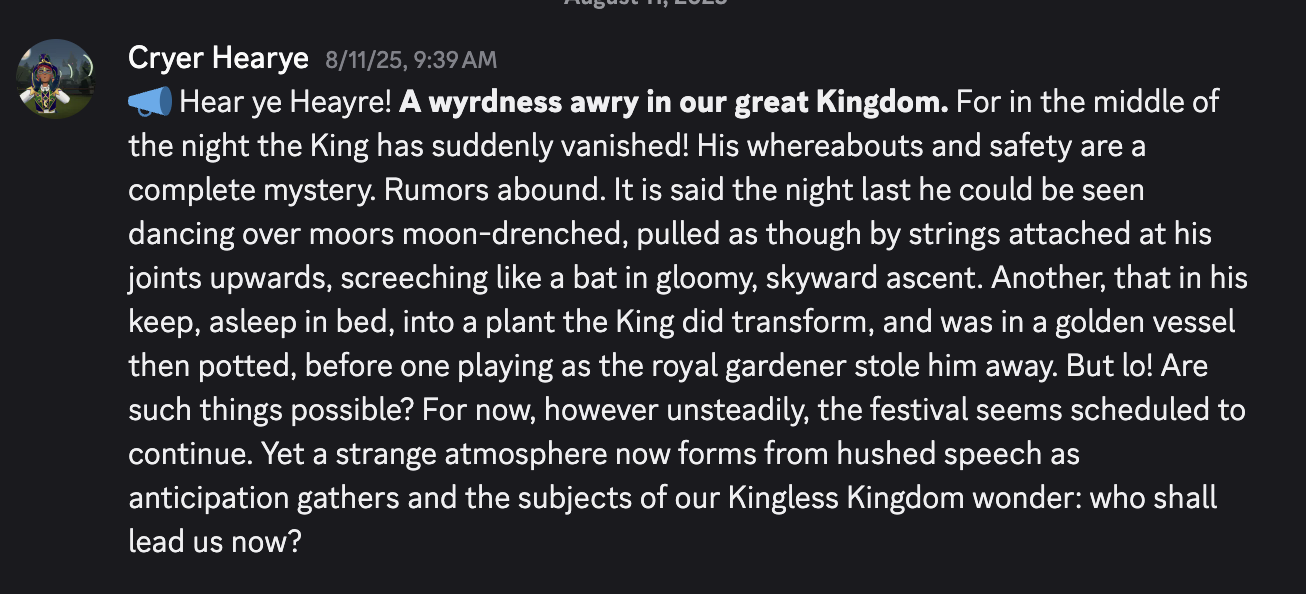
The language and tone of my writing with these posts is, to be sure, outside the comfort level of most 11-16 year old English speakers. I have always preferred to avoid condescending your audience, and think it is better to court their curiosity, extending a welcome invite to whichever dramatic pitch you want them to reach. I have an admiration for romantic horror, so I tried infuse this update with elements which may remind someone of stories like The Castle of Otranto and the like, while creating oblique references to other parts of the game, creating a "wyrd" air of mystery and presenting players with a more dramatic atmosphere than I think Rec Room had ever presented them with.
In the lull between the end of the Festival of Harvest Nobles and the start of the War of Harvest Nobles, we staged a fake election event to fill the vacuum that the King's disappearance created. Our Nobles, those influential players, which we had ahead of time chosen, were at this point told to begin campaigning the community in-game, on Discord, via their social media platforms, using their creative skills and whatever else to garner support for their nomination as the King's replacement.
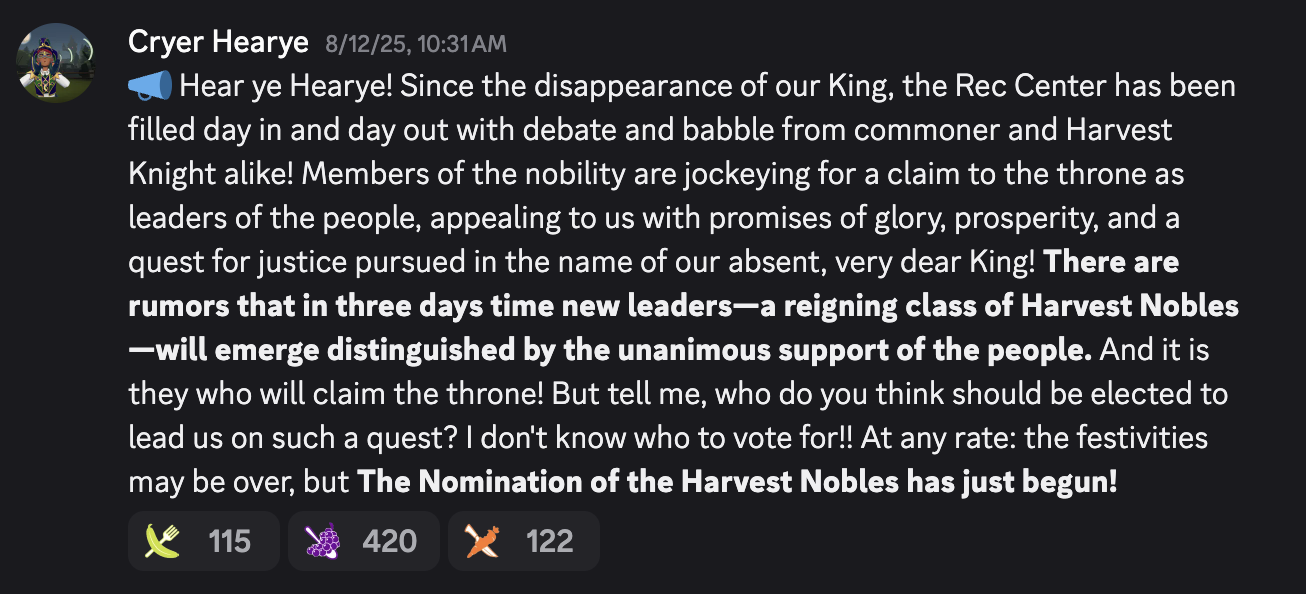
Nomination of the Harvest Nobles presented players with the drama of an election, inviting them to ally themselves with a particular faction by nominating a Noble house as governing leaders; but this was just smoke and mirrors. Behind the scenes, the three factions were already populated. Our Noble players had been informed that something like this was coming. Those who saw it mutually beneficial to drive hype for the event and their role within it ended up creating plenty of fun content during the three days the fake election ran.
Created by Drew (Source)
But of course, the election was doomed from the start, and when new leadership could not be agreed upon, from the ensuing power vacuum exploded a week-long conflict...
3. War of the Harvest Nobles
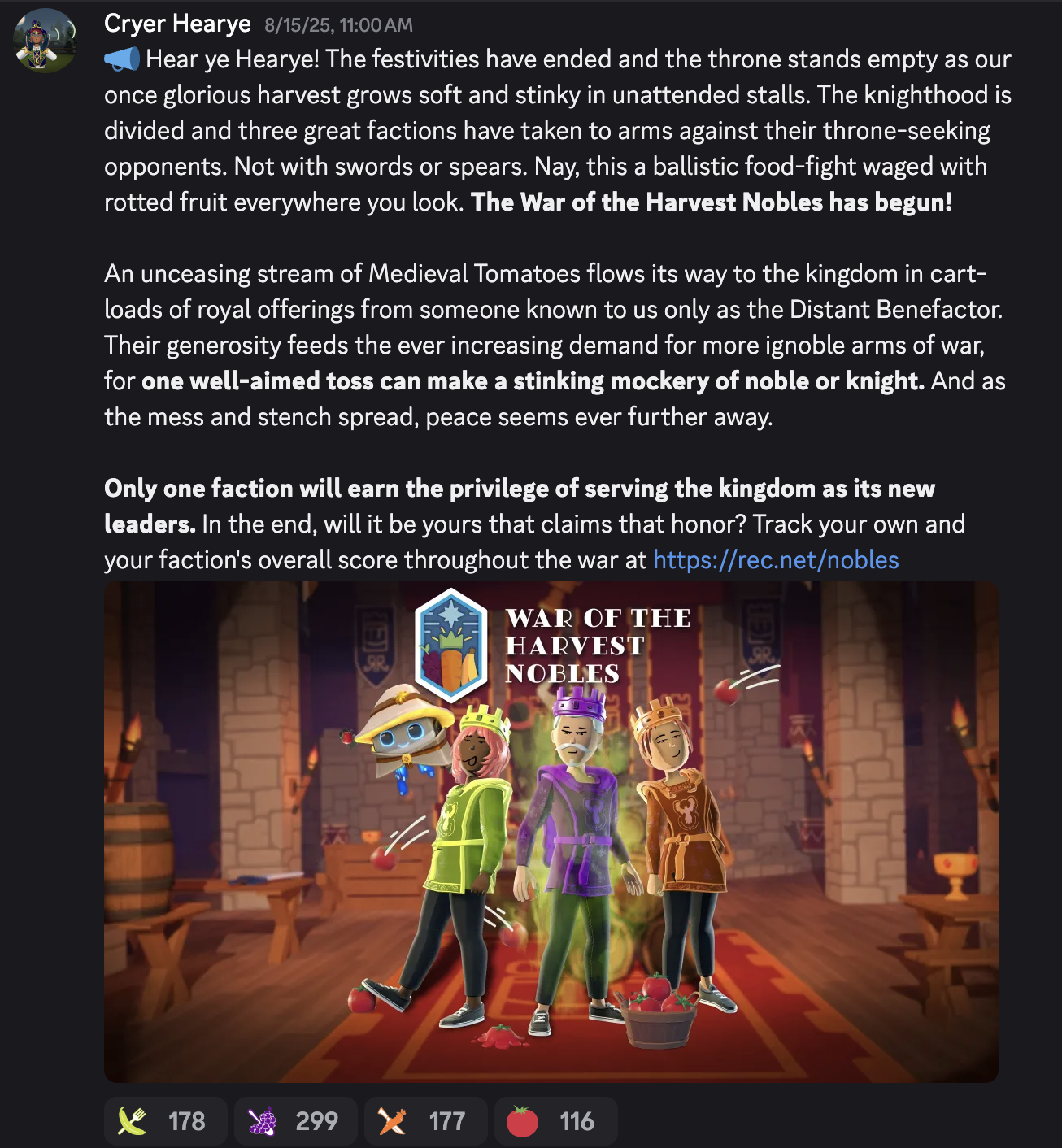
Beyond its technical challenges, we committed to a plan with War of the Harvest Nobles that would force us to contend with the unpredictable social dynamics of community engagement. We had to seek the cooperation of our Nobles, get our community invested in the atmosphere of the story, and, perhaps most importantly, explain the goals and mechanics of the event to our players with very little in the way of a tutorial.
The first operational road bump came when learning we wouldn’t be able to support the event with a trailer, our best hope for reaching players and explaining the rules of the event in a succinct but attention-grabbing way. I can't totally recall why this fell through when it was part of the plan all along. It felt strange, then, to not support a big event in such an important way. Luckily, our content creators, some of whom have great technical ability and far reach with their social media platforms, produced excellent videos summarizing the goals and mechanics of the event. Promoting their content through our own channels was mutually beneficial, and in the end there didn't seem to be any great confusion among reports from the community about the event.
Created by Dude (Source)
But the greatest trouble we ran into during the competition was to do with a performance misbalance, created by either one overperforming faction, the Rootforged, or an underperforming one, the Unripened. A mistake which must have contributed to this error originates weeks earlier when we first informed our Noble players about the event. Though it was never my intention to allow them to request assignment to particular factions, an internal miscommunication between myself and a colleague of mine who handled this outreach lead to a situation where the most active of our Nobles were heavily localized on the Rootforged. The plan always had been to balance against one faction outperforming all others; and though the Vineguard ended up neck and neck with the Rootforged in the end, I think this contributed to the disappointing performance of the Unripened faction. They were simply destitute of active and participating Noble players. So it was, just as with Glitch Grenades, but in a microcosmic and contained segment of the competition's participants, that some players were faced with a much greater challenge if they wanted to be competitive.
Rather than conclude that I should have been the one to handle this communication, playing at a fantasy of total control through design, I actually think the lesson here is to strive to create robust designs that can still accomplish your goals when parts of the execution inevitably fall short of your ideal. After all, it's obvious to anyone who has been a teacher, or refereed a roleplaying game, or spent any time designing a narrative event like War of the Harvest Nobles that embracing surprises and practicing reactivity is really the only sustainable way to pursue the craft while nourishing the development of an inspired agency among the people in your audience—your students and players, who are most certainly your artistic collaborators.
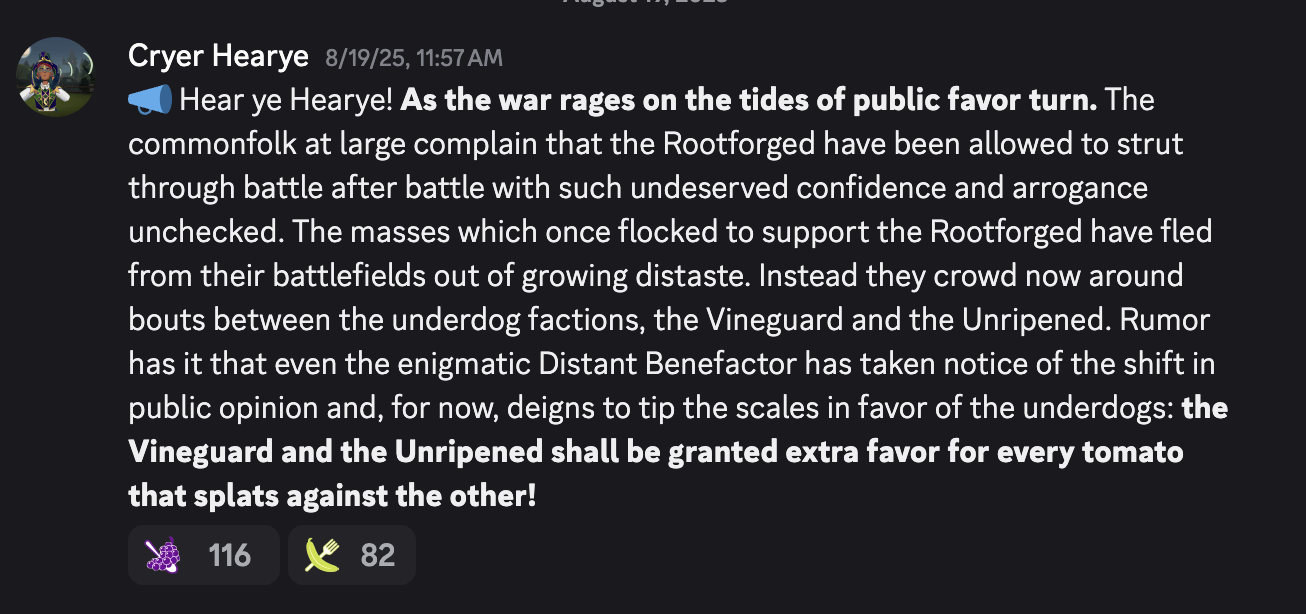
One way we attempted to respond in this kind of spirit involved offering two factions a multiplier to points earned from successful hits with tomatoes for a small period of time. The Unripened had been falling further and further behind both the Vineguard and the Rootforged for several days when we decided to attempt this. As previously mentioned, the Rootforged Nobles were, in addition to being wealthy and influential, quite coordinated (watch the rather funny "I Broke Rec Room's Biggest Event..." by overall winner and Rootforged Noble, BearDaBear, for a clearer picture). Counterbalancing this with an arbitrary advantage would, I worried, prove controversial and lead to an upset. But it seemed unlikely that even with a point multiplier applied the Unripened would be able to overtake either of their opponents. And there were still plenty of days to the competition left. I hoped any negative feelings spurred by the multiplier would be offset by the drama its announcement might create, invigorating the meager Unripened to strive for success, stealing the spotlight from the Rootforged and setting a fire underneath them.
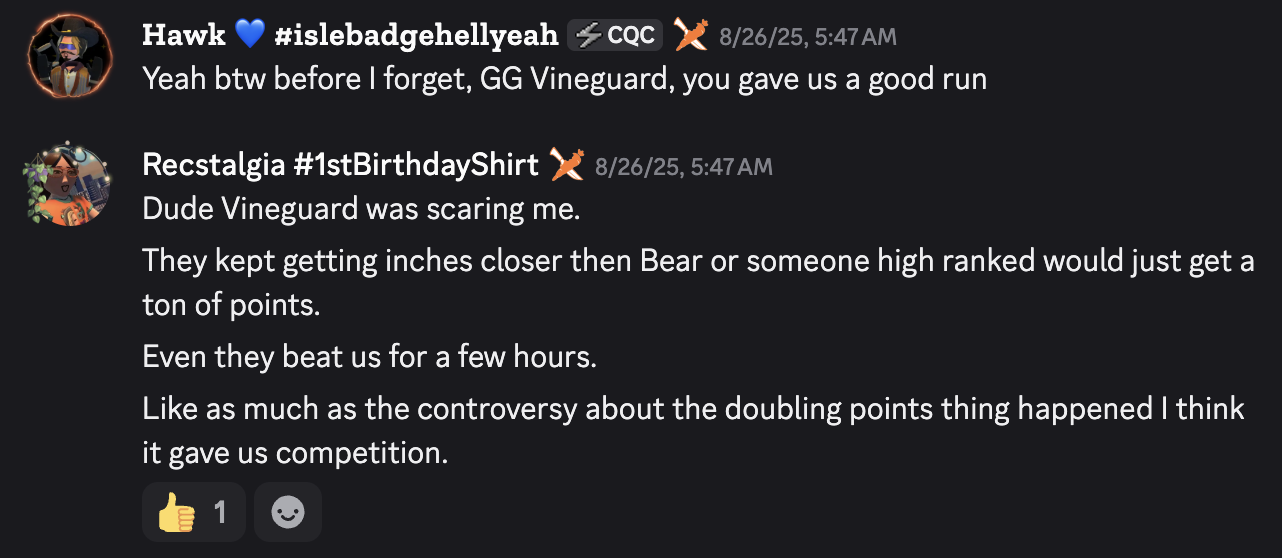
Just as hoped, the multiplier resulted in a little bit of good-spirited drama among invested players without resulting in an upset. It's even possible that the end of the War of the Harvest Nobles, which saw Vineguard and Rootforged stealing first place from each other over and over, would never have reached the tortured pitch of excitement it managed without us reacting to the state of the competition in the way we had. It's always a risk to rely on reactivity, especially with big productions, but I think the wins you sometimes stumble into when wandering through the deliberately constructed blank spaces of your plan are often wonderful in exactly this sort of way.
4. Meaning of the Harvest Nobles
All the work we put into orchestrating a scenario that would play out in a novel, inclusive, and fun way paid off with increased revenue and excited praise by the community. I was told by a former colleague of mine, my producer, Aaron, with a few days of the competition left, that the event had sustained an average daily revenue increase of 6% and courted the participation of more than 16% of our daily active users. That's great news for the business. But to have my design and writing lead to something so exciting and lively was immensely affirming. The drama of the competition, the suspense it created, and the playful creativity on display in the videos and rooms and banter told me that the vision I had so confidently advocated for, and was given a chance and a team to actualize, had actually made sense to our players. I found a great source of validation as well every time I would hear a player say something to the effect that, in a year where Rec Room had done so much to alienate trust with inane LLM projects and baldly pay-to-win events, War of the Harvest Nobles was an event they could feel happy participating with.
When the idea for War of the Harvest Nobles came to me, I felt like there was a pervasive and ill-hearted desperation behind almost all of our decision making, busying ourselves by creating experiences which valued the wealth of the economic whales in our community above all, and developing LLM technology that didn't appeal to anyone including the wealthy investors it was always meant to attract. Behind the scenes there were frequent reminders and dismissals of player sentiment which spoke to a growing dissatisfaction with Rec Room as a place to have fun. Meanwhile, as workers, it seemed to me we were toiling to create work that communicated more often than not a disdain for everyone but the wealthy and profit-driven, or, perhaps worse, didn't care what it communicated at all. And, day by day, it was growing clearer to everyone I worked with that soon enough many of us would be losing their jobs in an inevitable layoff.
I always intended War of the Harvest Nobles to be an activity that players could somehow make their own, separate from, or perhaps just in a way that tried to be in opposition to, the violent capitalistic structures of free-to-play mobile game economies. Introducing faction and inter-faction warfare into the established, single-leaderboard design of Glitch Grenades was generally useful for the purposes of creating something novel and accessible without diminishing the efficacy of the competition's monetization. But as I said near the end of the first section of this piece, it was a structure designed to create the appearance of an interrelatedness which showed that the story of the way the war progressed was also the story of the role you played within it.
That interrelatedness, I thought, made sense as an abstract representation of class difference in society; transforming War of the Harvest Nobles from a romp about "Nobles" and "Knights" waging a war with tomatoes into a playful allegory about the self-selecting logic of a class system where wealth and influence are synonymous with power. In a story like this a knight might distinguish themselves on the leaderboard as a Knight among knights. But in a class system that listens only to the power of nobility, a Knight among knights is ultimately just a knight among Nobles. I wanted War of the Harvest Nobles—in its production, orchestration, or as thing people just played with—to serve as a situation for people within Rec Room and without to enact a critique of a system of class division and the concomitant ideology perpetuated by people which the system must constantly coerce into maintaining it.
I can't know for certain whether the event played any part in helping a player articulate their own feelings as a subject of capitalism, or clarified their relationship to the product and business that is Rec Room. But I can take pride in having appropriated what little bit of the capitalist spectacle I could get my hands on, and for trying to do something good with it.
At the end of this long, long devlog shot through with ample amounts of arrogance and pride, it's time to acknowledge a regret. I wish there had been time to celebrate with my colleagues. Before the layoffs hit us on the 25th, but somehow after the war had ended on the 26th. I wish there was still a chance to thank everyone, amidst the company of each other, for contributing to the creation of something meaningful—or else just something very cool that a lot of people had fun working on and playing with. Alone at my desk on the 26th August recovering from COVID, writing the last Cryer Hearye post to conclude the event, I remember how it felt to take the metaphorical stage alone without any of my callaborators left to call on to take that last bow with me. In concluding this hard labored post, I want to just force the occasion and invite all of you to join me once again...
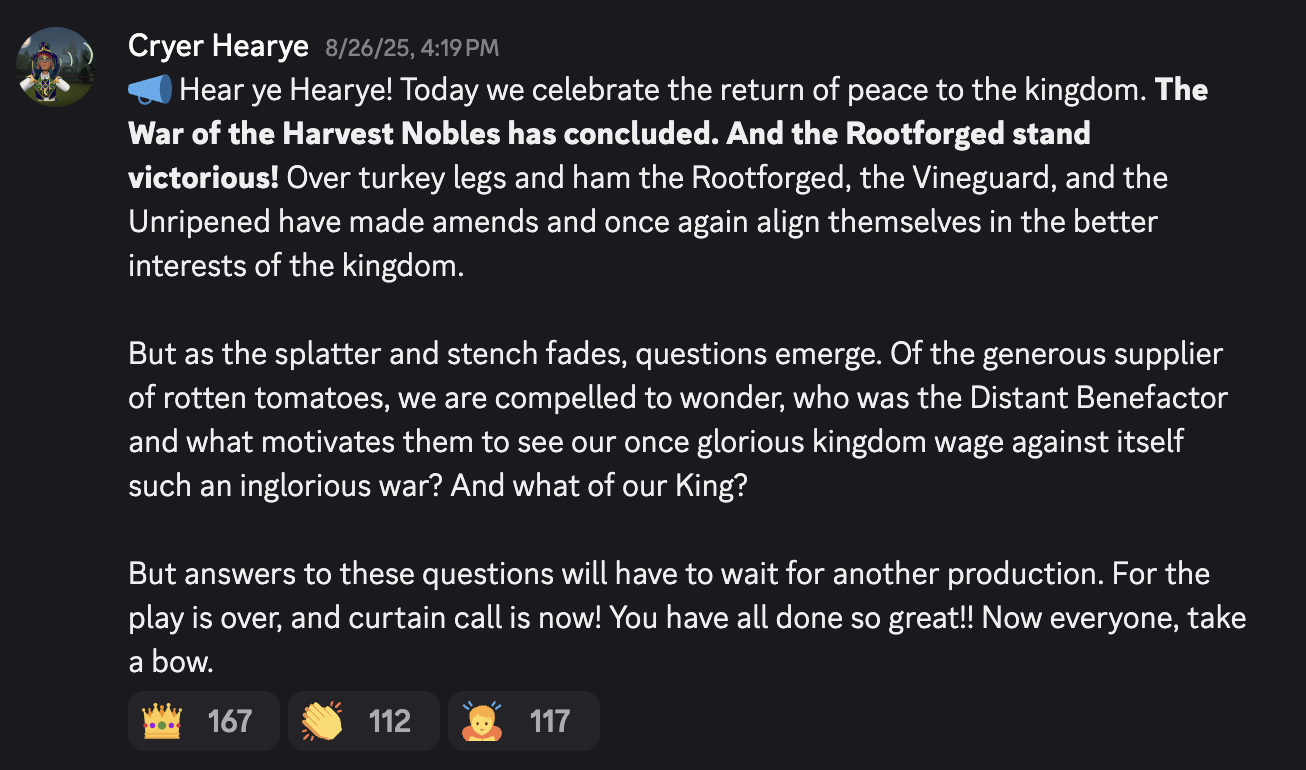
Aaron, Ethan, David, Carly, Caitlyn, Cat, Christa, Garret, BJ, Corbin, Jackson, Marco, Eugene, Max, Landon, Chris, Drew, Wes, Megan, Kristin, Nicholas, Monica, Skip, Shelby, Laura, Seth, Jordan, Carlos, Jessi, Josh, Travis, Lex, Zephyr, Stephen, Cody, Jacob, Noah, Jason, Yvette, Tyler, Ricky, Jamie, Ann, Emerson, Joe, Mike, Shawn, Isabelle, Scott, Caro, CJ, Zach, Tai, Riley, Pate, Laura, Haley, Cassi, Hailey, Eliza, Shaun, Robin, Tori, Gwyn, Andy, Phylissa, Cole, Peter, David, Tiffany, and Eric
—Braden 01.27.2026